
Dead Wood Removal in Glasgow
Safe removal of dead and hazardous branches across Glasgow, from NPTC-qualified risk assessment through to cherry-picker access and full site clean-up.
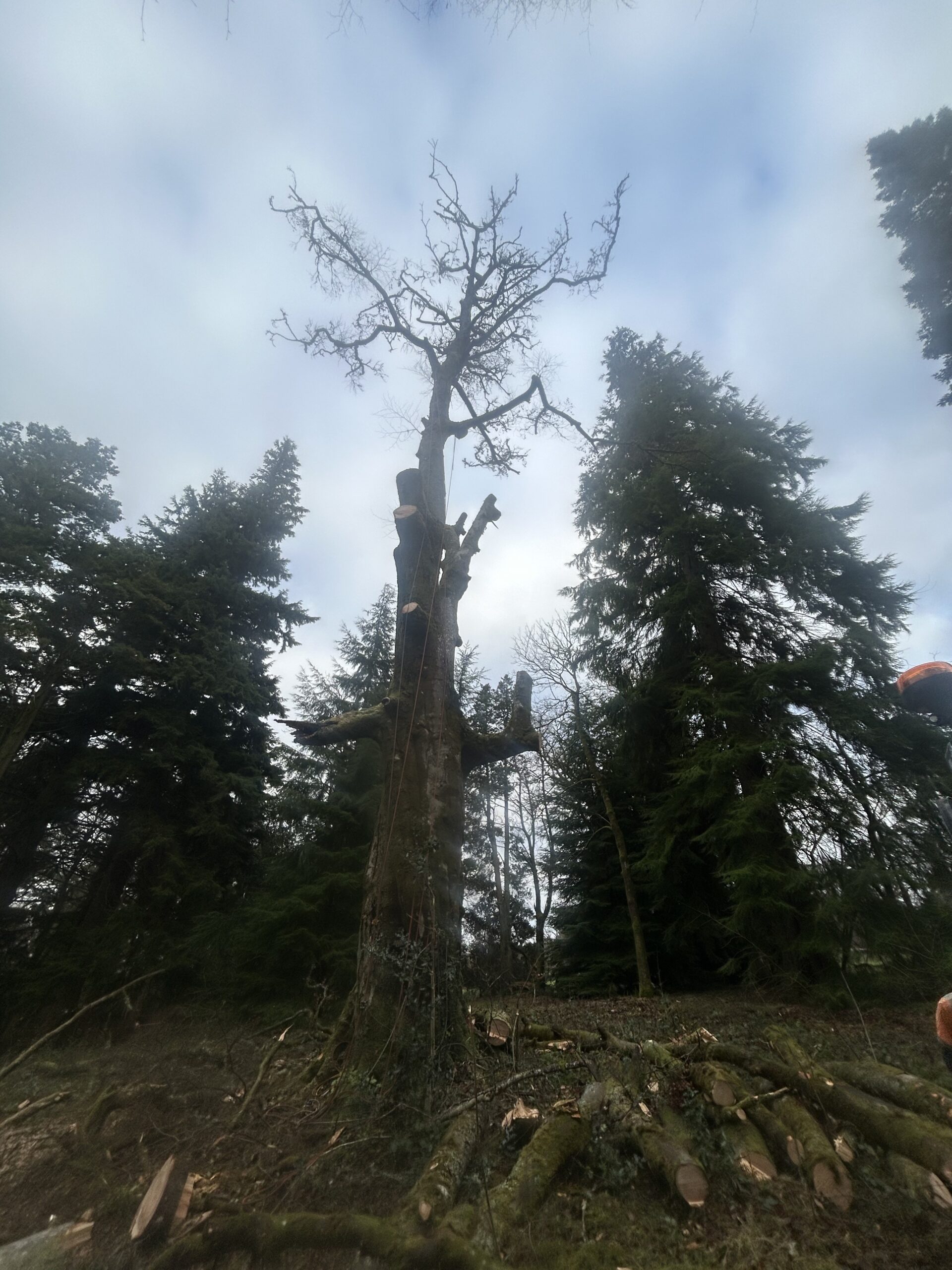
Dead wood removal in Glasgow is one of those jobs that looks simple from the pavement and isn’t, once you’re actually up in the canopy working out which limbs are safe to leave and which ones are ready to drop on the next windy Tuesday. A tree doesn’t die all at once – it sheds parts of itself gradually, and by the time you can see grey, bark-less wood from your kitchen window, that branch has usually been dead for a couple of seasons already. We deal with this on garden trees, street trees and boundary trees across Glasgow every week, and it’s rarely an all-or-nothing decision – a lot of the time the tree itself is perfectly healthy and just needs the deadwood taken out so it stops being a liability.
If you want the wider picture of how deadwooding fits alongside pruning, crown reduction and felling, our tree services page runs through the full range of work we do on top of this.
At a Glance
- NPTC-qualified risk assessment before any cutting starts, not a guess made from the pavement
- Our own tracked spider lift cherry picker on the fleet, so high deadwood doesn’t mean waiting on hired plant
- Every dead branch we cut is processed locally – into our own woodfuel or chipped for biomass, not sent to landfill
What We Cut, Leave and Flag on a Deadwooding Job
- Removal of dead, dying and hung-up branches throughout the crown, not just the obvious ones visible from the ground
- Climbing or cherry-picker access to reach deadwood high in the canopy without felling the tree
- Cutting back to the branch collar or to live wood, so the tree can seal the wound properly rather than being left with a torn stub
- Removal of deadwood caused by earlier poor pruning, storm damage, root disturbance, disease or shading from neighbouring trees
- Sectional lowering of heavier dead limbs on rigging ropes where they can’t simply be dropped clear
- On-site chipping of brash, plus either removal of all arisings or logging up timber for you to keep – whichever suits you
- A basic visual check of the rest of the crown while we’re up there, flagging cavities, cracks or fungal brackets even if they’re outside the original job
- Full clean-up of sawdust, chip and offcuts from paths, drives and lawns before we leave
Not Included / Costed Separately
- A full written BS5837 survey or risk-graded report – if you need something for a mortgage, planning application or a landlord’s liability file, that’s quoted as its own job, not folded into a standard deadwooding visit
- Diagnosis or treatment of the underlying disease or decay causing the deadwood – we’ll tell you what we think is going on, but lab-confirmed fungal diagnosis isn’t part of this service
- Felling the whole tree, if inspection shows the deadwood is a symptom of terminal decline rather than something worth cutting round – that’s a separate conversation and separate price
- Specialist access equipment for genuinely awkward sites, such as a crane where a tree can’t safely take a cherry picker or a climber – priced once we’ve seen the tree, not included in a standard quote
- TPO or Conservation Area application fees and council processing time, if consent is needed first – we handle the paperwork, but the council’s timeline isn’t ours to set
How a Deadwood Callout Runs, Start to Finish
- Call and rough description: You tell us roughly what you’re seeing – dead branches over a drive, a garden, a neighbour’s fence – and roughly how big the tree is. That’s usually enough for us to book a site visit rather than guess a price over the phone.
- On-site assessment: One of our climbers, or Callum himself as our NPTC Professional Tree Inspector, looks at the tree from the ground and, where it matters, checks bark texture, fungal fruiting bodies and any cavities before deciding what needs to come out and how it’s best reached.
- Access decision: Climbing with rope and harness, our own tracked spider lift cherry picker, or a mix of both on awkward sites – decided on the day based on ground conditions, overhead cables and how sound the deadwood looks to climb past safely.
- The cut: Each dead limb is cut back to live wood or to the branch collar, not just snapped off, so the tree can compartmentalise the wound properly. Anything too heavy to drop free is lowered on a rope to protect whatever’s underneath – a shed roof, a car, a border.
- Chipping and clean-up: Brash goes through the chipper on site; larger sections are logged up for you or taken away. Timber big enough for our woodfuel division goes there, and everything else gets chipped for landscaping mulch or biomass.
- Sign-off: We walk the site with you before we leave, point out what’s been done and anything worth keeping an eye on, and settle up on the spot – no follow-up invoice for surprises.
Deadwood Removal Cost in Glasgow: The Real Range
Pricing for this kind of work in the UK generally runs from around £150 to £350 for a smaller, single-tree deadwooding job, rising towards £400-£500 or more where it shades into a fuller prune – deadwood plus some crown thinning or reduction done in the same visit – per current 2026 UK tree care price guides. Where your job lands in that range depends on things a phone call can’t tell us: how tall the tree is, whether we can get a cherry picker onto the site or need to climb, how much deadwood there actually is once someone’s up in the crown (there’s almost always more than you can see from the ground), and whether we’re taking the wood away or leaving it logged for your own fire. A site visit costs you nothing and is the only way we’ll give you a figure we’re prepared to stand behind – a price guessed from a description over the phone helps nobody once we’re standing under the tree looking at what’s genuinely there.
Deadwooding, Reduction, Pollarding or Felling?
| Approach | What it does | When it’s the right call | Downside |
|---|---|---|---|
| Deadwood removal | Takes out dead or dying limbs only, leaves the living crown intact | Tree is otherwise healthy but carries hazardous dead branches | Doesn’t address why branches are dying if there’s an underlying disease or root problem |
| Crown reduction / thinning | Reduces the overall size or density of the living crown | Tree is structurally sound but too large, too dense, or overhanging something it shouldn’t | More disruptive to the tree and more costly than deadwooding alone |
| Pollarding | Cuts the crown back to a framework of stubs, repeated on a cycle | Species suited to it (willow, lime) in a spot needing tight, ongoing size control | Not appropriate for most species and creates a repeat maintenance commitment |
| Felling | Removes the whole tree | Deadwood turns out to be a symptom of terminal decline, decay or root failure | Loses the tree’s amenity, habitat and any TPO value entirely - a last resort, not a first one |
Reading a Dead Limb Correctly Before We Cut It
Grading deadwood correctly is where most of the actual skill in this job sits, not the cutting itself. The same grey, bark-stripped branch can be a five-minute cut or the first visible sign that a tree needs a much closer look at what’s happening below ground, and telling those two apart from a stepladder or a phone photo is exactly how people end up either paying for work that wasn’t needed or leaving something genuinely hazardous hanging over a path. We look at where the deadwood sits in the crown, whether it’s an isolated limb or spread through several branches, and whether the bark lifts away cleanly or the wood underneath is already soft – that second sign usually means decay has moved further into the tree than the dead branch alone suggests. A hung-up limb, caught in the crown rather than fully down, gets treated differently again, because it can already be detached at one end and ready to drop the moment it’s disturbed, regardless of whether anything else in the tree needs work. Getting that reading right before anyone climbs is what keeps a routine deadwooding visit routine, rather than turning into a surprise halfway up the tree. Every cut is made to BS3998 and backed by £5 million public liability cover, because a branch that’s misjudged over a road, a car or a neighbour’s fence is precisely the risk this job exists to remove.
Where Glasgow’s Deadwood Actually Turns Up, and Why
We’re based at Newton Place in Glasgow’s West End, and our standard ten-mile radius from there covers most of where we’re called out to look at dying branches. The pattern isn’t spread evenly across that radius, and it isn’t the same pattern everywhere. In the West End and Pollokshields, a good share of the calls come from mature lime, beech and sycamore planted well over a century ago along streets around Hyndland, Dowanhill, Kelvinside and Hillhead – on trees this old, deadwood tends to show up as one or two dry limbs isolated in an otherwise dense, healthy crown, so the job is often a single targeted removal rather than a full pass through the tree. On higher, more exposed ground near the Cathkin Braes and along the southern edge of the Campsies above Milngavie and Torrance, deadwood behaves differently again – wind does more of the killing than age does, and what we usually find is a limb that’s sheared under gusting rather than dried out gradually, with paler, fresher wood visible at the break instead of the grey, weathered look of something that’s been dead a couple of seasons, which changes how quickly we’d want to deal with it once it’s spotted. The clay-heavy ground through the Clyde basin adds a third pattern worth knowing about: it drains slowly, roots sit wetter than they would on lighter soil, and root stress from waterlogging often doesn’t show as deadwood until a season or two later, usually higher in the crown rather than near the base – worth knowing if one side of a street seems to be losing more limbs than the other. We check Tree Preservation Order and Conservation Area status before quoting on protected streets across Glasgow City, East Dunbartonshire and East Renfrewshire ground, since removing dead wood from a protected tree still usually means telling the council first. Commercial and estate deadwood work takes us further across Scotland; the ten-mile radius above is what we hold to for standard garden and street trees.
Images
Frequently Asked Questions
Why is deadwood removal important for tree health?
It isn’t really about the tree’s health in the way most people expect – a tree with deadwood in it isn’t necessarily unwell, since shedding branches it no longer needs is a normal part of how a mature tree manages its own canopy. The health angle is more about reducing entry points for decay fungi, since dead wood left in contact with living wood can let rot travel inward, and improving air flow through a dense crown, which cuts down on fungal and pest pressure in wetter spells. But the main reason most people call us out is safety, not tree health – dead branches behave in ways live wood doesn’t.
Can dead branches fall without warning?
Yes, and this is the part people underestimate. Live wood usually gives some warning before it fails – creaking, visible cracking, slow bending in wind. Dead wood doesn’t behave the same way, because the fibres have already dried out and lost flexibility, so a branch that’s looked fine for two years can come down in a moderate gust with no notice at all. That’s why we treat deadwood over anywhere people park, walk or sit as a priority rather than something to leave until it’s convenient.
How do I know if my tree has a lot of deadwood in it?
From the ground, look for branches with no leaves in summer when everything else on the tree is in full leaf, bark that’s peeling or missing compared to the rest of the crown, and a grey, brittle look rather than the darker, slightly flexible look of live wood. The tricky part is that deadwood higher up or towards the back of the crown is often invisible from the ground entirely, which is why a trained eye checking crown density and canopy shape from height tends to turn up more than homeowners expect.
Is deadwood removal covered under a TPO exemption?
There’s a limited exemption in most Tree Preservation Orders for removing dead branches from a living tree, and for felling a tree that’s entirely dead – but it’s not a blank cheque. Councils can still ask for five days’ notice before you rely on that exemption, and it doesn’t cover branches that are dying rather than fully dead, which is a judgement call worth getting right rather than assumed. We check TPO and Conservation Area status before quoting anything in Glasgow’s protected areas, because getting this wrong can mean a retrospective enforcement notice, which is a worse outcome than waiting a week for consent.
How often should deadwooding be carried out?
There’s no fixed schedule that suits every tree – it depends on species, age and site. As a rough guide, a mature tree overhanging a garden, driveway or path is worth having looked at every two to three years, and sooner after any named storm has been through the west of Scotland. Younger, healthier trees with less canopy density generate far less deadwood and can often go longer between checks.
Does deadwood attract pests or disease?
Dead wood on a living tree can be an entry point for wood-decay fungi, and standing deadwood does attract wood-boring insects – though that’s not automatically a bad thing, since it’s also genuinely valuable habitat for beetles, some bird species and fungi, which is exactly why blanket removal isn’t always the right advice. The concern from a homeowner’s point of view is less about pests spreading through the rest of the tree and more about the deadwood itself failing structurally over someone’s head.
Does removing all deadwood conflict with biodiversity guidance that treats deadwood as valuable habitat?
This is a real tension in the trade, not just a talking point. Deadwood is one of the most valuable habitat features a tree can offer, supporting invertebrates, fungi and cavity-nesting birds, and current best-practice guidance generally favours retaining deadwood where it isn’t a risk to people or property, rather than stripping a crown bare. In practice, our approach on a garden tree away from anywhere people gather is often to leave low-risk deadwood in place, and reserve full removal for deadwood that’s actually over a target – a path, a drive, a seating area, a boundary with a neighbour. We’ll talk you through that distinction rather than cutting everything back purely because it’s dead.
What’s the difference between hung-up deadwood and structural deadwood risk?
Hung-up deadwood is a branch, or a whole small limb, that’s already broken but has caught in the crown on the way down rather than reaching the ground – it can look stable but isn’t attached to anything, and can drop the moment it’s disturbed by wind or by someone working nearby, which makes it one of the more dangerous things we deal with rather than less. Structural deadwood risk is different – a branch still attached and sound-looking at the base, but dead enough along its length that it’s lost the strength to carry its own weight in wind loading. Both need dealing with, but hung-up material changes how we plan the job, since it can move without any cutting at all.
Do you offer a deadwood risk-grading report suitable for landlord or factor liability records?
We can, yes. Callum’s NPTC Professional Tree Inspector qualification covers exactly this kind of assessment, and for landlords, factors or anyone managing a tree with an insurance or liability angle, we can produce a written, risk-graded record of what deadwood was found, what was removed, and what – if anything – we recommend keeping under review. This is quoted separately from a standard deadwooding visit, since it takes longer on site and needs writing up properly afterwards.
Why Choose CNJ Tree Services?
Scotland's leading comprehensive tree and property service company.
60+ Specialist Tree Services
From basic pruning to de-vegetation and complex ecological assessments
30+ Years of Experience
Core team made up of highly experienced third-generation tree surgeons
24-hour Availability For Emergencies
Average response time under 2 hours
Up to £5M
Insurance Cover
Comprehensive cover for complete peace of mind
Professional Credentials
NPTC, Lantra, FMO and NPORS certified professionals ensuring the highest standards of safety and expertise on every project.
Environmental Expertise
Ecological surveys and compliance specialists
Contact Us Today
What Our Clients Have Said About Us
Jackie Breen
From the first time getting in touch with Callum, the service was fantastic, he came out gave us a great quote and was able to do the job very quickly. The boys that came to carry out the work were professional, friendly and worked non stop to get the job done, they were so careful with machinery on the property as well and left the garden and paths spotless before they left. I would highly recommend them.
"
Alan
Callum and his team arrived on the agreed day & time, carried out the tree felling with impeccable professionalism and cleared up after. The work was done at the quoted price and they were very pleasant guys with no bad language. I highly recommend CNJ and I will certainly be using Callum and his 5 star tree fellas again.
"
Robin Campbell
Callum and his team felled four 40-foot+ trees in our garden, facing particular challenges (2 trees hanging over our LPG tank, one menacing a precious rhododendron). They worked incredibly hard, were great to deal with and we would thoroughly recommend them.
"
Our Service Areas
We Cover All of Glasgow and West Scotland
Primary Coverage
- Balfron
- East Dunbartonshire
- Glasgow City
- Killearn
- Renfrewshire
- South Lanarkshire (selected areas)
- Stirling
- Strathblane
- West Dunbartonshire
Key Locations
• Balfron • Bearsden • Bothwell • Clarkston • Clydebank • East Kilbride • Fintry • Giffnock • Hamilton • Killearn • Kippen • Kirkintilloch • Milngavie • Newton Mearns • Paisley • Strathblane • Stirling
Emergency Response
50-mile radius
Commercial Projects
We undertake commercial projects across Scotland.
Don’t Wait For the Next Gale to Find Out
Deadwood doesn’t get safer by waiting – it gets drier, lighter and more likely to let go without warning, and west of Scotland weather doesn’t hold off for a convenient weekend. If you’ve spotted bare, brittle branches over a drive, a path or a neighbour’s fence, get in touch and we’ll get a qualified eye on it, usually within a few days rather than weeks.
CNJ Tree Services
Address
Office 1, Technology House,
9 Newton Pl, Glasgow G3 7PR, United Kingdom