
Tree Insurance Claims Support Glasgow | CNJ Tree Services
When a tree comes down in a storm, cracks a driveway with root growth, or ends up at the centre of a dispute with a neighbour, your insurer’s first question is usually what caused the damage, not simply that it happened. That causation opinion has to come from someone qualified to give it, which is why our claims support sits alongside the practical side of the job - felling a dangerous tree, carrying out the site clearance an approved claim pays for, or working on the crown reduction a subsidence dispute sometimes turns on instead of outright removal.
Call before anything is cut back or moved if you’re able to, because the photographs and notes taken on that first visit become the start of your evidence file. We’ll tell you honestly whether a claim looks realistic before you pay for anything, and if your insurer asks for a formal written report, it’s produced to the same BS5837 standard used for planning-grade tree surveys - written to answer the question an adjuster’s own arboriculturist would ask, rather than to read as one side’s version of events.
This sits within our wider tree services work in Glasgow, since the same crew handling routine felling, pruning and site clearance is also the one writing the report your insurer will read, so there’s no gap between the assessment and the work that follows it.
At a Glance
- NPTC Professional Tree Inspector-qualified reports, written to the BS5837 risk-assessment standard insurers already recognise
- Every assessment and site visit backed by £5 million public liability insurance
- Photographic evidence logged on site before any remedial work touches the tree, so nothing gets lost before the insurer sees it
- Team includes NPTC-trained climbers and machine operators such as Ron Bowes-Taylor and Neill Tannahill, so evidence gathering and any approved remedial work draws on 15+ years of on-site experience, not a single assessor working alone
City Areas: Merchant City, West End, South Side, East End, North Glasgow
Surrounding Areas: Paisley, East Kilbride, Hamilton, Motherwell, Coatbridge, Airdrie Extended
Coverage: Stirling, Falkirk, and throughout West and Central Scotland
Strategic location between Glasgow and Stirling enables rapid response with average emergency time under 2 hours.
Domestic Tree Insurance Claims Support Glasgow
Professional Tree Insurance Claims Assistance for Glasgow Homeowners
Emergency Tree Removal
24/7 Response
Free Tree Quote
Professional assessment within 48 hours
Complete Tree Services
General and Specialist Services Available
Storm Damage Response
Immediate Callout
CNJ Tree Services provides specialist domestic tree insurance claims support across Glasgow and surrounding areas, helping homeowners maximise their insurance settlements through professional documentation, expert assessments, and technical evidence. As part of our wider support for homeowners, you can also explore our full Tree Services Webpage, which details all domestic and specialist tree care solutions available throughout Glasgow and Central Scotland.
Our NPTC-certified arborists understand both insurance requirements and Glasgow’s unique tree-related challenges, ensuring your claim receives the professional support needed for successful resolution.
Navigating tree-related insurance claims can be overwhelming for Glasgow homeowners, especially when dealing with storm damage, subsidence, or liability disputes. Insurance companies require detailed documentation, professional assessments, and technical evidence that most homeowners cannot provide independently, often resulting in reduced payouts or rejected claims.
📞 FREE Tree Insurance Claims Assessment - Call 0141-340-9722
What Is Domestic Tree Insurance Claims Support?
Why Choose Our Tree Service
Liability Claims: Damage caused by your trees to neighbouring properties or damage caused by neighbour’s trees to your property.
Emergency Claims: Dangerous trees requiring immediate removal for safety reasons, often covered when presenting imminent threat to property or persons.
Unlike commercial tree insurance support that handles large-scale claims and business interruption, domestic tree insurance claims support focuses on residential property protection, family safety, and home insurance policy navigation. Our residential approach includes personal guidance, homeowner education, and family-focused solutions.
Insurance companies require technical evidence, professional documentation, and expert assessments that typical homeowners cannot provide. Professional support significantly increases claim success rates whilst reducing stress and ensuring proper compensation for tree-related damage.
Need commercial property support? Explore ourCommercial Tree Insurance Claims designed for business and development insurance requirements.
📞 Emergency Tree Insurance Documentation - Call 0141-340-9722
Domestic tree insurance claims support is a specialised service that helps homeowners navigate tree-related insurance claims through professional documentation, expert assessments, and technical evidence required by insurance companies. This service bridges the gap between homeowner needs and insurance requirements, ensuring claims are properly supported and documented.
Types of Tree Insurance Claims We Support:
Storm Damage Claims: Fallen trees, broken branches, and wind damage requiring immediate documentation and professional assessment to establish cause and extent of damage.
Subsidence Claims: Tree root damage to foundations, driveways, and structures requiring soil analysis, root identification, and structural engineering reports.
Types of Domestic Tree Insurance Claims
Storm and Weather Damage Claims:
Fallen Tree Damage: Trees or branches damaged by wind, lightning, or hail that cause property damage. Coverage typically includes structural repairs and tree removal when trees hit buildings or block access.
Emergency Tree Removal: Dangerous trees damaged by storms requiring immediate removal to prevent further damage. Insurance may cover removal costs when trees pose imminent threat to property.
Subsidence and Root Damage Claims:
Foundation Damage: Tree roots causing subsidence, cracking, or structural movement requiring structural engineering assessment and root identification.
Drainage Damage: Tree roots blocking or damaging underground drainage systems, requiring excavation and professional assessment of root intrusion.
Liability and Neighbour Disputes:
Third Party Damage: Your trees causing damage to neighbouring properties, requiring liability assessment and professional documentation of tree condition.
Neighbour Tree Damage: Damage to your property from neighbour’s trees, requiring evidence of negligence or assessment of coverage under your own policy.
Preventive and Maintenance Claims:
Safety Hazard Removal: Insurance may cover tree removal when trees present documented safety hazards requiring immediate action.
Post-Damage Assessment: Professional evaluation following minor damage to determine extent of coverage and prevent future claims.
Each claim type requires specific documentation, professional assessments, and technical evidence to satisfy insurance requirements and maximise settlement potential.
📞 Professional Claim Assessment Available - Call 0141-340-9722
Professional Tree Insurance Claims Process
Phase 1: Initial Claim Assessment and Documentation
Our specialists respond rapidly to assess tree damage, document evidence, and begin the claims process immediately whilst preserving crucial evidence that insurance companies require for successful claims.
Immediate Response Services:
- ✅ Emergency site attendance - Rapid response within 2 hours for dangerous situations
- ✅ Photographic documentation - Comprehensive evidence recording before any remedial work
- ✅ Safety assessment - Immediate evaluation of ongoing risks and emergency stabilisation
- ✅ Initial insurance contact - Notification to insurance companies with preliminary assessment
- ✅ Evidence preservation - Protecting crucial evidence whilst ensuring property safety
Phase 2: Professional Assessment and Documentation
Our certified arborists conduct detailed assessments meeting insurance requirements, providing the technical evidence and professional documentation necessary for successful claims.
Comprehensive Documentation Includes:
- ✅ Structural tree assessment - Professional evaluation of tree condition and failure cause
- ✅ Root system analysis - Soil testing and root identification for subsidence claims
- ✅ Photographic evidence portfolio - Detailed visual documentation from multiple perspectives
- ✅ Professional reports - Technical documentation meeting insurance and legal standards
- ✅ Maintenance history analysis - Review of previous care and warning signs
Phase 3: Claims Support and Advocacy
We work directly with insurance adjusters, providing professional evidence and technical expertise to support your claim and ensure proper assessment of damage and required remedial work.
Ongoing Support Services:
- ✅ Adjuster communication - Professional liaison with insurance representatives
- ✅ Additional evidence provision - Supplementary documentation as required
- ✅ Claim dispute support - Expert testimony and evidence for disputed claims
- ✅ Settlement negotiation support - Professional advocacy for fair compensation
- ✅ Follow-up services - Ongoing support throughout claims process
📞 Professional Claims Liaison Available - Call 0141-340-9722
Documentation and Evidence Requirements
Essential Documentation for Tree Insurance Claims:
Photographic Evidence:
Pre-Incident Photos: Evidence of tree condition before damage, preferably showing healthy appearance and proper maintenance.
Post-Incident Documentation: Comprehensive photography from multiple angles showing extent of damage, safety hazards, and property impact.
Progressive Documentation: Ongoing photographic record showing development of damage or deterioration.
Professional Assessment Reports:
Arboricultural Reports: Professional tree condition assessment by certified arborists, including species identification, health evaluation, and failure analysis.
Structural Engineering Reports: Technical assessment of building damage, foundation impact, and repair requirements for subsidence claims.
Soil and Root Analysis: Laboratory testing and root identification for claims involving tree root damage to foundations or drainage systems.
Maintenance and Care Records:
Inspection History: Previous professional tree inspections and maintenance records demonstrating responsible ownership.
Work Completion Certificates: Documentation of previous tree work, pruning, or safety measures undertaken.
Warning Documentation: Any previous professional advice or warnings about tree condition or safety concerns.
Insurance Documentation:
Policy Review: Analysis of coverage terms, exclusions, and claim limits relevant to tree damage.
Claims History: Previous tree-related claims or property damage affecting current claim assessment.
Professional Correspondence: All communication with insurance companies, adjusters, and assessors.
Legal and Liability Evidence:
Neighbour Communications: Documentation of any warnings given or received regarding tree safety concerns.
Council Correspondence: Any communication with local authorities regarding tree preservation orders or safety issues.
Expert Witness Statements: Professional opinions supporting liability assessment or technical claims.
📞 Professional Documentation Services - Call 0141-340-9722
Why Choose Professional Tree Insurance Claims Support?
Expertise in Insurance Requirements:
Technical Knowledge: Understanding exactly what documentation and evidence insurance companies require for successful tree damage claims.
Policy Interpretation: Professional analysis of coverage terms, exclusions, and limits affecting your specific claim situation.
Industry Relationships: Established relationships with insurance adjusters and understanding of company-specific requirements and procedures.
📞 Professional Claims Expertise - Call 0141-340-9722
Frequently Asked Questions
What tree damage is covered by home insurance in Glasgow?
Home insurance typically covers tree damage caused by sudden, accidental events like storms, wind, lightning, or fire. This includes fallen trees damaging your roof, walls, or other structures, and often covers tree removal costs when trees hit buildings or block access. Covered scenarios include: Storm-damaged trees hitting your property, branches broken by high winds causing structural damage, lightning strikes causing tree failure, and emergency tree removal when trees pose immediate safety threats. Common exclusions include: Gradual damage from tree roots, preventive tree removal, maintenance-related issues, and damage from obviously diseased trees that should have been addressed. Professional assessment helps determine coverage eligibility and maximise claim potential.
Do I need professional help for tree insurance claims?
Professional help significantly improves claim success rates, particularly for complex claims involving substantial damage, liability disputes, or technical issues like subsidence. Insurance companies require detailed documentation and technical evidence that most homeowners cannot provide independently. Professional benefits include: Insurance-standard documentation, technical evidence meeting company requirements, expert communication with adjusters, and advocacy ensuring fair treatment and appropriate compensation. When professional help is essential: Claims over £5,000, disputed liability situations, subsidence or root damage claims, and cases where insurance companies challenge cause of damage or extent of required repairs.
How do I prove tree was healthy before storm damage?
Previous inspection records and maintenance documentation provide strongest evidence of tree health before storm events. Professional photographs showing healthy condition, growth patterns, and proper maintenance support claims that damage resulted from weather rather than pre-existing issues. Evidence supporting healthy conditions includes: Recent arboricultural reports, maintenance records and photographs, professional inspection certificates, and witness statements from neighbours or contractors familiar with tree condition. Professional support creates: Comprehensive documentation packages, expert testimony regarding typical tree failure patterns, and technical analysis supporting storm damage claims versus pre-existing condition disputes.
Will insurance pay for emergency tree removal?
Insurance typically covers emergency tree removal only when trees pose immediate threats to property or block access routes. Coverage is usually limited to £500-£1,000 and requires documentation that removal is necessary for safety or access rather than convenience. Covered emergency scenarios: Trees blocking driveways preventing emergency vehicle access, dangerous hanging branches threatening structures, partially fallen trees creating safety hazards, and trees damaged by storms requiring immediate stabilisation. Documentation requirements include: Professional assessment of safety hazard, photographic evidence of immediate threat, written confirmation that removal prevents further damage, and compliance with insurance company notification procedures.
Am I liable if my tree damages a neighbour’s property?
Liability depends on negligence and tree condition before failure. If your tree was healthy and failed due to storm or natural causes, your neighbour typically claims on their own insurance. However, if the tree was obviously diseased or dangerous and you failed to address it, you may be liable for damages. Factors affecting liability: Tree health and maintenance history, whether hazards were obvious or reported, professional warnings or assessments ignored, and local authority notices or preservation orders affecting tree management. Professional protection includes: Regular inspection records demonstrating responsible ownership, professional assessments supporting tree health claims, and expert testimony in liability disputes protecting against false negligence claims.
What evidence do I need for tree insurance claims?
Comprehensive photographic documentation from multiple angles, professional arboricultural reports, and maintenance records form the foundation of successful tree insurance claims. Evidence must demonstrate cause of damage, extent of impact, and necessary remedial work. Essential documentation includes: Before and after photographs, professional tree condition assessment, structural engineering reports for building damage, soil analysis for subsidence claims, and maintenance history demonstrating responsible ownership.
How long do I have to report tree damage to insurance?
Immediate notification is essential for tree damage claims, typically within 24-48 hours of discovery. Delayed reporting allows insurance companies to question whether damage resulted from reported incidents or subsequent events. Critical timing requirements: Immediate safety measures and professional assessment, notification to insurance company within policy timeframes, preservation of evidence before any remedial work, and professional documentation while damage is clearly visible. Professional emergency response ensures: Immediate evidence preservation and documentation, proper insurance notification procedures, safety measures preventing further damage, and compliance with all policy requirements affecting claim validity.
📞 Dispute Resolution Support - Call 0141-340-9722
Why Choose CNJ Tree Services for Tree Insurance Claims Support
- Specialist Glasgow Tree Insurance Expertise
- Professional Insurance Industry Knowledge
- Homeowner-Focused Service
- Complete Claims Support
📞 Trusted Glasgow Tree Insurance Specialists - Call 0141-340-9722
Get Your FREE Tree Insurance Claims Assessment Today
Don’t Navigate Complex Insurance Claims Alone: Tree-related insurance claims require professional documentation, technical evidence, and expert advocacy that significantly impact settlement amounts. Without proper support, homeowners often receive reduced payouts or face claim rejections that could have been avoided.
Glasgow Coverage Areas
City Areas: Merchant City, West End, South Side, East End, North Glasgow
Surrounding Areas: Paisley, East Kilbride, Hamilton, Motherwell, Coatbridge, Airdrie
Extended Coverage: Stirling, Falkirk, and throughout West and Central Scotland
Strategic location between Glasgow and Stirling enables rapid response with average emergency time under 2 hours.
Get FREE quote - Call 0141-340-9722
Ready to Maximise Your Tree Insurance Claim?
Contact CNJ Tree Services today for your FREE claims assessment. Our insurance specialists will evaluate your situation and provide expert guidance ensuring optimal claim resolution and appropriate compensation.
📞 Call Now: 0141-340-9722
Tree emergency with insurance implications? We provide immediate response with professional documentation ensuring your claim receives proper support from the outset.
Gallery of Previous Work Done
Why Choose CNJ Tree Services?
Scotland's leading comprehensive tree and property service company.
60+ Specialist Tree Services
From basic pruning to de-vegetation and complex ecological assessments
30+ Years of Experience
Core team made up of highly experienced third-generation tree surgeons
24-hour Availability For Emergencies
Average response time under 2 hours
Up to £5M
Insurance Cover
Comprehensive cover for complete peace of mind
Professional Credentials
NPTC, Lantra, FMO and NPORS certified professionals ensuring the highest standards of safety and expertise on every project.
Environmental Expertise
Ecological surveys and compliance specialists
What Our Clients Have Said About Us
Jackie Breen
From the first time getting in touch with Callum, the service was fantastic, he came out gave us a great quote and was able to do the job very quickly. The boys that came to carry out the work were professional, friendly and worked non stop to get the job done, they were so careful with machinery on the property as well and left the garden and paths spotless before they left. I would highly recommend them.
Alan
Callum and his team arrived on the agreed day & time, carried out the tree felling with impeccable professionalism and cleared up after. The work was done at the quoted price and they were very pleasant guys with no bad language. I highly recommend CNJ and I will certainly be using Callum and his 5 star tree fellas again.
Robin Campbell
Callum and his team felled four 40-foot+ trees in our garden, facing particular challenges (2 trees hanging over our LPG tank, one menacing a precious rhododendron). They worked incredibly hard, were great to deal with and we would thoroughly recommend them.
Our Service Areas
We Cover All of Glasgow and West Scotland
Primary Coverage
- Balfron
- East Dunbartonshire
- Glasgow City
- Killearn
- Renfrewshire
- South Lanarkshire (selected areas)
- Stirling
- Strathblane
- West Dunbartonshire
Key Locations
• Balfron • Bearsden • Bothwell • Clarkston • Clydebank • East Kilbride • Fintry • Giffnock • Hamilton • Killearn • Kippen • Kirkintilloch • Milngavie • Newton Mearns • Paisley • Strathblane • Stirling
Emergency Response
50-mile radius
Commercial Projects
We undertake commercial projects across Scotland.
Contact Us Today
What Claims Support Includes - and Where It Stops
- A free initial site visit to look at storm or subsidence damage and give an honest view on whether a claim is worth pursuing
- Photographs, measurements and written notes on species, condition and likely cause, logged before any remedial work touches the tree
- A formal report from an NPTC Professional Tree Inspector, written to BS3998/BS5837 standard, where your insurer or loss adjuster asks for one
- Identification of root involvement in subsidence cases, supplying the arboricultural evidence a structural engineer or adjuster needs
- Direct contact with your insurer’s loss adjuster or arboriculturist to talk through the technical detail on your behalf
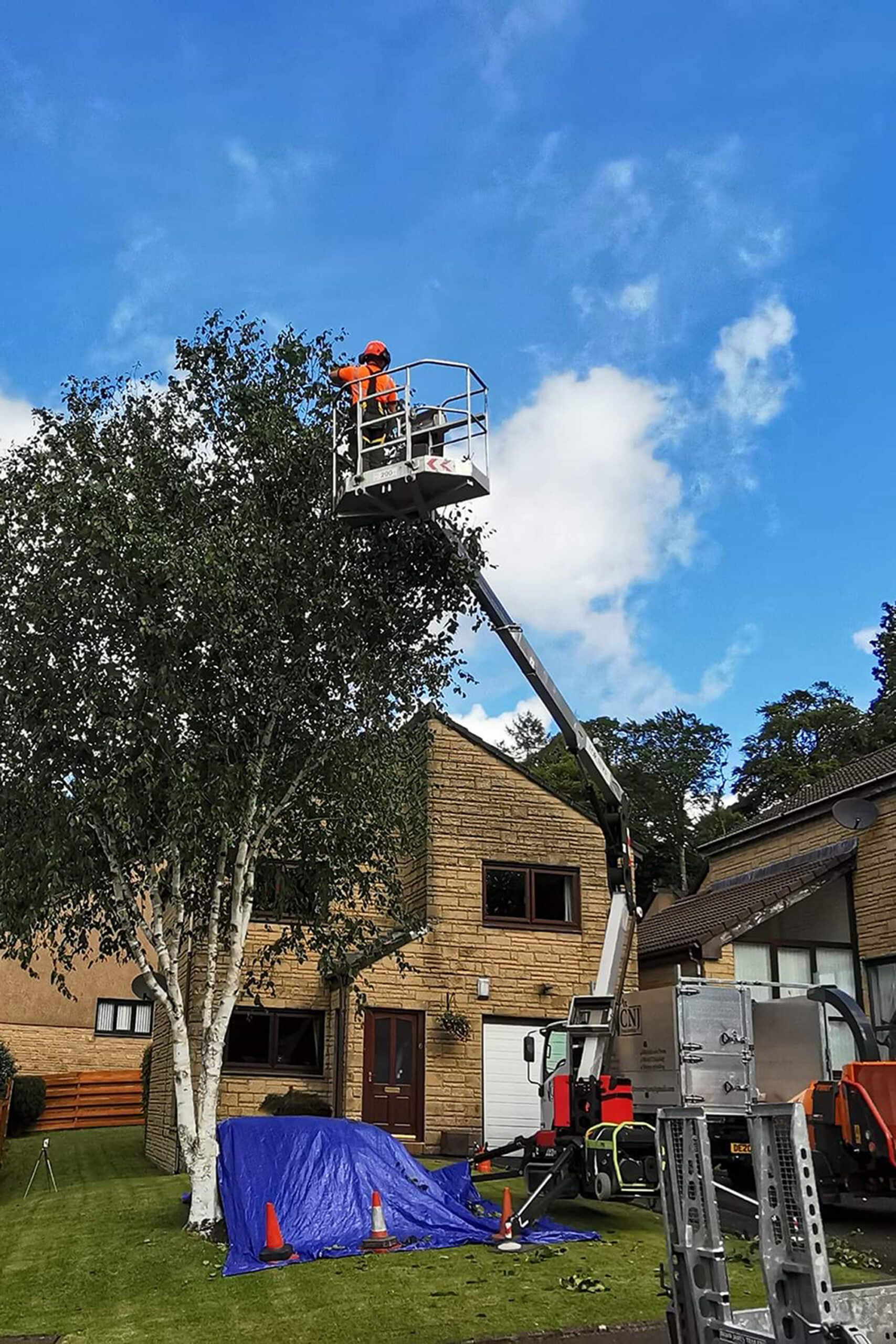
- Felling, crown work or site clearance once a claim is approved, carried out by the same crew that assessed the damage, using our own cherry picker, excavators and forwarders rather than hired-in plant
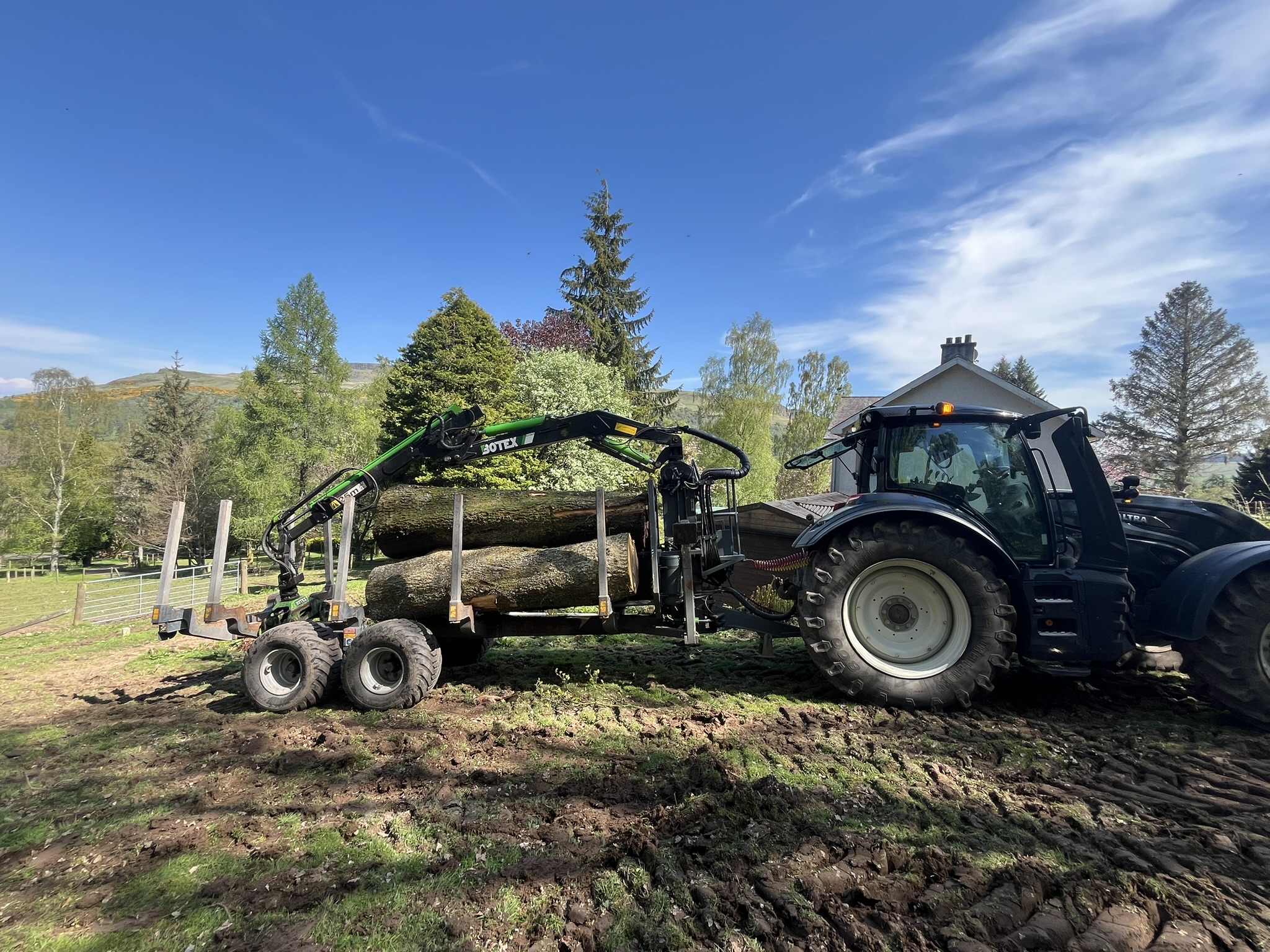
- Coordination with FMO-licensed forwarder and 360 excavator operators where a large or windblown tree needs mechanised dismantling as part of the evidence-gathering and remedial process
Not Included / Costed Separately
- Deciding or guaranteeing your claim’s outcome or settlement figure - that decision is made by your insurer’s own adjuster, not by us
- Structural engineering reports for foundation, drainage or subsidence damage - we can identify root involvement and supply the arboricultural evidence a structural engineer needs, and can put you in touch with one, but the structural report itself sits outside an arborist’s qualification
- The remedial building work an approved claim pays for - roof, wall, drainage or driveway repairs are a separate trade from the tree removal, pruning and site clearance we carry out
- Formal legal representation in a disputed claim - our written reports and site evidence support a case, but we’re not solicitors and don’t act as your legal representative
- Paying your policy excess or costs outside your cover - our free initial assessment gives you an honest view of what’s realistically claimable, but the excess itself is between you and your insurer
How a Tree Insurance Claim Actually Gets Handled
- First call and free site assessment: You describe what’s happened - storm damage, a crack that’s appeared near a tree, or a dispute over a neighbour’s tree - and we get out to look at it in person. For storm-related emergencies we run a 24/7 response within a 50-mile radius, usually arriving in under two hours; for a subsidence or boundary question there’s less urgency, but you’ll still get an honest view of whether a claim looks realistic before anything else happens. Where FMO-licensed forwarder or 360 excavator work is needed to reach a windblown tree safely, that’s arranged as part of the same visit rather than a separate call-out.
- Evidence gathered before any work starts: Photographs, measurements and notes on species, condition and likely cause are recorded before a chainsaw touches the tree, so the record an insurer eventually sees reflects the damage as it actually was, not what’s left once remedial work has tidied it up.
- A formal NPTC report, if your insurer asks for one: Where a loss adjuster wants a signed document rather than photographs, Callum Jackson - NPTC Professional Tree Inspector qualified in 2023 - writes it to BS3998/BS5837 standard, covering species, condition, likely cause of failure and recommended remedial work. The same report format is used whether the claim covers a single storm-damaged tree or a more involved subsidence dispute, so an adjuster reviewing several files from us sees a consistent structure each time.
- Direct contact with your adjuster: We’re happy to talk your insurer’s arboriculturist through the technical detail directly rather than leaving you to relay it, which tends to move a decision along faster than a written report sitting unopened in an inbox.
- Remedial tree work once a claim is approved: The same crew that assessed the damage carries out the felling, crown work or site clearance the claim covers, using our own cherry picker, excavators and forwarders rather than waiting on hired-in plant, so approved work doesn’t sit on a waiting list once cover is confirmed. Ron Bowes-Taylor and Neill Tannahill typically run the machinery side of this stage, since both operate the excavator and cherry picker day to day rather than only for claims work.
- Wrap-up and handover: Once the work is finished, any remaining paperwork - final photographs, waste and disposal records - goes to you or straight to the adjuster, whichever’s been agreed, so the file closes out cleanly. Any FMO or IPAF-certified plant used on site is logged in the same paperwork, so the record matches what an adjuster or loss assessor was told at the outset.
What You Pay For Assessment Versus a Formal Claims Report
The initial call-out to look at storm or subsidence damage and give you an honest view on whether a claim is realistic is offered free of charge, and the photographs taken on that visit form the start of your evidence file. Where an insurer or loss adjuster asks for a formal written arboricultural report - a signed, insurer-standard document covering species, condition, likely cause of failure and recommended remedial work - that is charged as a separate professional service, because it represents a qualified assessor’s time rather than a site visit. What it costs depends on the complexity of the claim: a single fallen tree with straightforward storm damage takes less time to document than a subsidence dispute involving root identification across several trees, or a liability claim where a neighbour’s insurer is contesting the cause. A firm price only comes once we’ve seen the tree, the damage and the site in person, so treat any figure given over the phone as a starting point rather than a final number. Where a claim covers mechanised dismantling of a large or storm-damaged tree, the cost reflects our own plant - cherry picker, forwarders and excavators - being used directly rather than a third-party operator being booked and billed separately, which keeps the invoice closer to a single line item for your adjuster to review. Founder Callum Jackson, who has worked professionally with chainsaws for around 18 years, sets the scope for larger jobs personally rather than leaving it to an estimate written from photographs alone.
DIY Photos vs a General Contractor vs an NPTC-Qualified Claims Report
| What you get | Doing it yourself | General tree cutter | CNJ claims support |
|---|---|---|---|
| Evidence an insurer accepts | Phone photos with no professional sign-off | A basic invoice, usually with no formal assessment | A report from an NPTC Professional Tree Inspector, written to BS3998/BS5837 standard |
| Liability cover behind the work | None | Varies, often none | £5 million public liability insurance |
| Contact with your adjuster | You explain the technical detail yourself | Rarely offered | We liaise directly with the adjuster on your behalf |
| Site clearance if the claim’s approved | A separate contractor has to be found and briefed from scratch | Same contractor, but without a documented assessment history | The same team that assessed the damage carries out the work, so nothing is lost in handover |
Why Insurers Take Our Reports Seriously
Insurers rarely take a homeowner’s word that a tree failure was unavoidable - a loss adjuster is trained to ask whether the damage was genuine storm bad luck or the result of a defect that should have been picked up earlier, and often brings in their own arboriculturist to argue exactly that. What holds up against that kind of scrutiny is a report that answers the causation question directly: was there a visible crack, a fungal bracket, included bark, or root plate movement that made failure foreseeable, or was this a sound tree that simply lost to wind it couldn’t have been expected to withstand. Callum Jackson qualified as an NPTC Professional Tree Inspector in 2023 - the same qualification used to write planning-grade BS5837 surveys - so that causation opinion is argued to a standard an insurer’s own consultant already works to, rather than something to dispute on sight. Reports are written to BS3998 and BS5837 for the same reason: it keeps the document in language an adjuster recognises rather than reading as one side’s account of what happened. Speed matters too, because owning our cherry picker, forwarders and excavators outright rather than hiring plant in means a hazardous tree can be made safe within days of the first call - which counts for something when cover depends on a risk being controlled promptly rather than left to worsen while a subcontracted crew gets booked in. £5 million public liability insurance sits behind both the assessment visit and any remedial work that follows, so the same cover protecting your evidence trail also protects the work once a claim is approved. That mechanised approach runs through the wider team as well: Ron Bowes-Taylor, our team lead, climbs and operates machinery with 15 years in the industry behind him, Neill Tannahill keeps the fleet itself running as chief engineer while also felling and operating the 360 excavator, and Ryan Spark handles large-diameter felling over 380mm with a rescue-trained background from his time as an outdoor instructor. Between them, a claims job that needs both a technical report and hands-on dismantling doesn’t wait on an outside subcontractor for either half of the work.
Domestic Claims Support Within Our Glasgow Service Radius
The claim we’re called out for tends to depend on what’s under the property rather than how far it is from our Newton Place base, so it’s worth explaining the ground before the postcode. Subsidence disputes cluster on the clay-heavy soil either side of the Clyde and the Kelvin, in tenement streets such as Partick, Hyndland, Dowanhill, Kelvinside, Hillhead and Maryhill, where a root system planted decades ago can dry out or shift footings gradually enough that nobody notices until a wall or driveway cracks - and because a good stretch of that same ground carries a Tree Preservation Order or sits inside a Conservation Area, with Pollokshields and the West End still holding enough Victorian-era planting for this to come up often, establishing who had consent to work on the tree, and when, is usually the first phone call rather than the last: that means Glasgow City, East Dunbartonshire or East Renfrewshire’s planning team before an adjuster will engage with root evidence at all. Higher, more exposed ground asks a different question entirely - near the Cathkin Braes, the Kilpatrick Hills and the southern edge of the Campsies above Bearsden and Milngavie, a tree can stand for a century and still come down in one bad gust, so the argument there turns less on soil and more on whether a defect was visible before the wind found it. That three-way split between slow subsidence, sudden storm failure and a boundary dispute over whose tree caused what is what actually gets assessed on any call-out, from Clydebank, Renfrew and Bishopton in the west to Kirkintilloch and Bishopbriggs in the north and Giffnock, Newton Mearns, Barrhead and the edge of East Kilbride to the south - all within the ten-mile radius we work from Newton Place. IPAF and NPORS certification covers the cherry picker and 360 excavator operators sent out on these jobs, and FMO licensing covers the forwarder and skidder work needed when a large or windblown tree has to come down in sections rather than as a single felling cut - relevant on the steeper ground near the Kilpatrick Hills and the Campsies edge as much as on a tenement street where access is tight.
Get Your Tree Damage Assessed Before the Evidence Is Lost
Storm damage and subsidence cracks don’t get easier to prove the longer they’re left - branches get cleared, cracks widen, and a loss adjuster asks harder questions the further you are from the event. Call for a free assessment while the damage is still fresh and provable, and you’ll get a straight answer on whether a claim is worth pursuing before you spend anything on it. Beyond claims support, the same team covers the full range of tree services a Glasgow property might need, from routine pruning to storm-damage removal, so the people who assess the damage are the same ones who can put it right once your insurer signs off.