
Tree Insurance Survey Glasgow | NPTC PTI Reports
NPTC Professional Tree Inspector Reports to BS3998/BS5837 for Insurers, Lenders and Subsidence Claims
If your insurer or mortgage lender has asked for a tree insurance survey in Glasgow, it usually means a tree sits close enough to a building, drain or boundary wall that an underwriter wants written proof of the risk before they will renew a policy, settle a claim or release funds on a purchase. Clay-heavy ground across the Clyde basin makes this a live issue for a lot of Glasgow properties, and once a solicitor or claims handler has set a deadline, the clock is already running. CNJ Tree Services carries out these inspections directly rather than farming the fieldwork out to a subcontractor: the same person who measures the tree against your foundations also handles any follow-on pruning, reduction or removal work the report recommends, and the survey can be widened into a fuller arborist inspection if your policy or lender wants more than a single-tree opinion.
Worth knowing before you book: an insurance survey is a written risk opinion aimed at an underwriter or lender, not the same document as a planning-grade BS5837 survey needed for an extension or new build near protected trees. The two get confused often, and paying for the wrong one wastes both time and money. A short conversation up front, describing what your insurer or solicitor has actually asked for, sorts out which report you need.
At a Glance
- NPTC Professional Tree Inspector qualified, not a generalist writing outside their training
- Reports built to BS3998 and BS5837 methodology, the standards insurers and planners recognise
- £5 million public liability cover backing every visit and every report
What Insurers, Lenders and Solicitors Actually Require in This Report
- A tree-by-tree schedule of every tree within influencing distance of the insured building, recording species, height, crown spread and estimated root spread
- Measured distances from each tree to foundations, drains, boundary walls and any other structure your insurer has flagged
- A note on soil type and drainage relevant to subsidence risk, including where clay content in the local ground raises or lowers likely root-related movement
- A visual tree assessment of each specimen for structural defects: deadwood, cavities, included bark, historic storm damage, previous poor pruning cuts
- A photographic record cross-referenced to the tree schedule, so the insurer can see exactly what was inspected
- A written risk opinion for each tree with a recommended action (leave and monitor, prune, reduce, or remove) and an approximate cost bracket for that work
- A signed PDF report formatted for submission to an insurer, lender or solicitor, referencing BS3998 and BS5837 where relevant
Not Included / Costed Separately
- A full BS5837 planning survey with a constraints plan and root protection area drawings for a planning application - this is a different, longer piece of work, quoted separately
- Root identification by excavation or root mapping - the report will recommend this where genuinely needed, but it is not part of the standard visual survey and is priced separately if instructed
- Soil sampling or laboratory analysis for a definitive subsidence diagnosis - where a case needs that level of proof, referral to a chartered structural engineer or arboricultural consultant is the honest next step, not something covered by this survey
- A full structural inspection of a neighbour's tree without access arranged - a visual opinion can be given from your side of the boundary, but entering next door needs their permission first
- The recommended tree work itself - the survey is the risk opinion, not the pruning or felling it recommends, though both can usually be quoted at the same visit
- Formal expert witness attendance at a tribunal or court hearing - available on request, priced and scoped individually rather than bundled into a standard survey fee
From Your First Call to a Report in Your Insurer’s Inbox
- Initial call: You describe the situation - a lender's request, a renewal query, a subsidence worry, a storm-damaged tree - and give a rough idea of property size and tree numbers, so a realistic price band and a survey date can be given over the phone rather than left vague.
- Site visit booked: A visit is arranged directly with you, not routed through a call centre or a subcontracted network, so the person who turns up on the day is the person who quoted the job.
- On-site inspection: The inspector measures each relevant tree against the building, checks the ground and drainage, and carries out a visual tree assessment for structural defects, photographing as they go rather than relying on memory once back at the office.
- Report drafted: Findings are written up against BS3998 and, where the case calls for it, BS5837 methodology, with a plain-English risk opinion sitting alongside the technical detail an underwriter needs to see.
- Report delivered: The finished PDF goes to you, or direct to your insurer, lender or solicitor if you'd rather it went straight to them, with the inspector's name and qualification on the cover page.
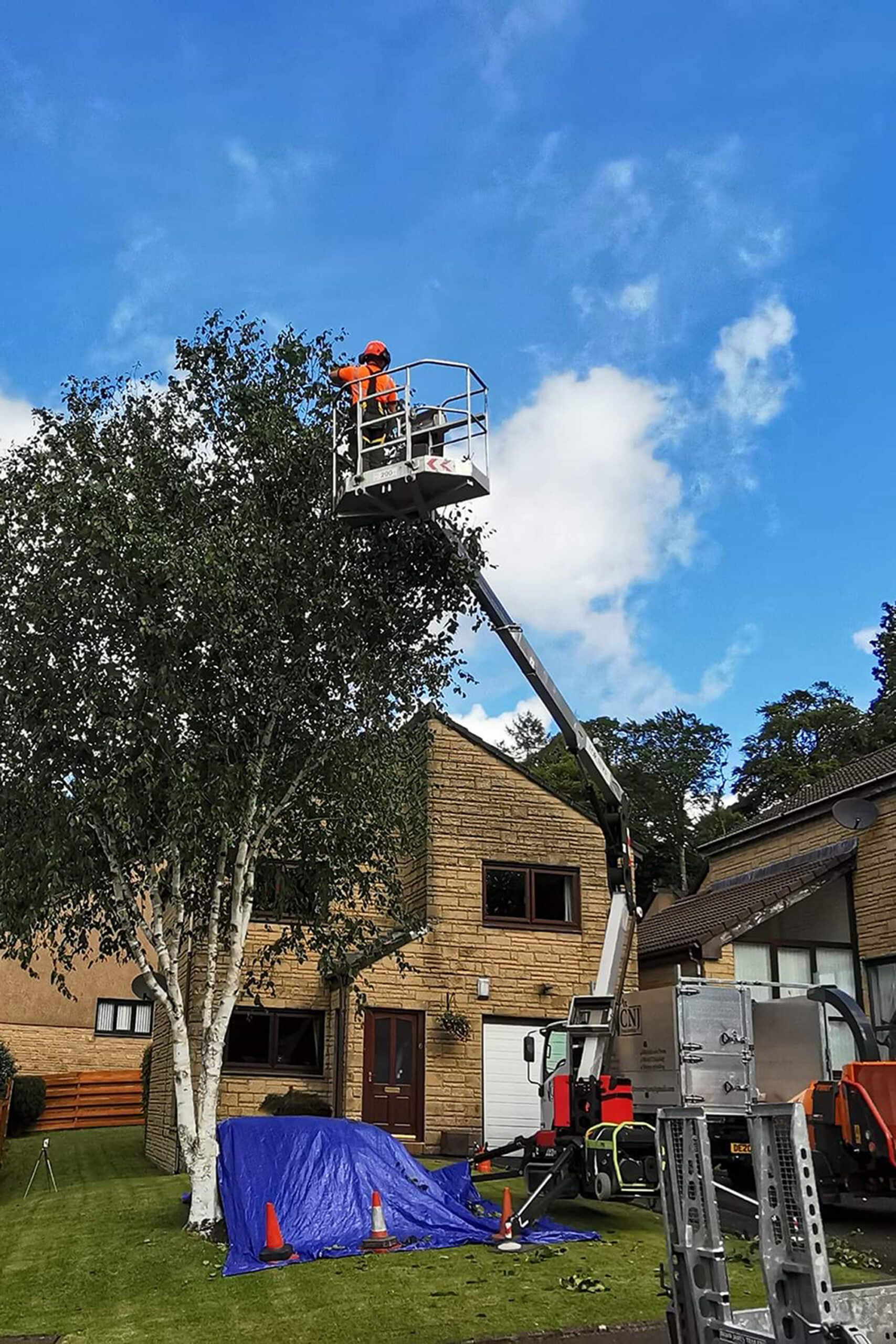
- Follow-up work, if recommended: Where the report recommends pruning, reduction or removal, the same crew can carry that out using CNJ's own cherry picker, excavators and chippers, rather than you having to find a second contractor and start again from scratch.
Typical Fees for an Insurance-Standard Survey
Across the UK, a single-tree targeted survey written for insurance purposes generally costs somewhere in the region of £300 to £420, and a subsidence-specific report - the kind an insurer asks for once root-related ground movement is suspected - typically starts from around £400 to £500 and rises from there depending on how many trees and how much investigation the case needs. Where you land in that range depends on the number of trees on and around the property, how many buildings or boundaries need distance checks, whether the soil and drainage picture needs a closer look, and how quickly the report is needed. A tight completion date or an out-of-hours visit tends to push the fee toward the top of the bracket rather than the bottom. None of this replaces an actual quote: a fair price for your specific property needs a site visit, because a single mature oak six metres from a bay window is a different job to five self-seeded sycamores against a garden wall, even if both look like “one survey” on paper.
How This Compares to a Generic Tree Report
| What your insurer or lender cares about | CNJ Tree Services | A generic tree report |
|---|---|---|
| Inspector’s qualification | NPTC Professional Tree Inspector (PTI), qualified 2023 | Often written by a tree surgeon with no PTI-specific insurance training |
| Reporting standard used | BS3998 and BS5837 methodology applied throughout | Varies widely; some reports amount to a one-page opinion letter with no cited standard |
| Follow-up tree work | Same crew can carry out any recommended pruning or removal, using CNJ’s own plant | Referral to a separate contractor, adding a second booking and a second wait |
| Public liability cover | £5 million | Not always held, or not stated on the report |
| Local ground knowledge | Familiar with Clyde basin clay and the Victorian tree stock in Glasgow’s conservation areas | Often written without local soil or planning context |
A Single Named Inspector, Not a Subcontracted Signature
An insurance survey lives or dies on whether the person signing it actually holds the qualification an underwriter’s technical team is trained to look for. Every CNJ report carries one name throughout - Callum Jackson’s NPTC Professional Tree Inspector certification, gained in 2023 - rather than being drafted by whoever happens to be free that week and checked over by someone else afterwards. The inspector who walks the garden and measures each tree against the foundations is the same person who writes the risk opinion and signs the cover page, so there’s no handoff between a fieldworker and a separate report-writer where detail gets softened or lost in translation, and no work farmed out to a subcontracted surveyor whose name never appears on the document at all. That single point of accountability matters because the judgement calls in a report like this - telling a cosmetic bark wound from a structural crack, or a decades-old lean from one that started last winter - come from someone who has actually stood under the tree in question, not from a checklist completed at arm’s length. Every report ties back to BS3998 for the tree work itself and BS5837 where planning-grade detail applies, backed by CNJ’s own £5 million public liability cover, so whoever reads it - a claims handler, a lender’s surveyor, a solicitor working to a completion date - is looking at a document built to the standard their own guidelines already expect, signed by the one person who can be asked to explain any line in it.
The Ground Conditions Behind These Surveys
For a subsidence-specific survey, the ground itself often matters more than which side of the city the tree happens to sit on: the clay that runs either side of the Clyde and Kelvin river valleys shrinks and swells with moisture in a way that can genuinely shift foundations, whereas the sandier, rockier ground out toward the Campsies or the Kilpatrick Hills rarely raises the same subsidence question - though gardens up near the Cathkin Braes or the Kilpatrick ridge tend to bring a wind-risk assessment into the report instead. A lot of the trees generating these surveys are older than the buildings beside them: Glasgow’s West End and Southside carry mature Victorian-era gardens, and where a tree flagged for reduction or removal sits inside a Conservation Area, the report has to note that Glasgow City, East Dunbartonshire or East Renfrewshire planning consent may be needed alongside the insurer’s sign-off - a complication a generic report can easily miss. Domestic surveys run within a ten-mile radius of CNJ’s Newton Place base in Glasgow’s West End, covering the city itself plus the surrounding towns: Clydebank and Paisley to the west, Bearsden and Bishopbriggs to the north, Giffnock and Newton Mearns to the south, Rutherglen and Cambuslang to the southeast. Storm-related insurance assessments are handled on a wider footing, with 24-hour emergency response out to 50 miles and an average arrival under two hours, and larger commercial or estate surveys are carried out across Scotland rather than being tied to the domestic radius.
Images
Frequently Asked Questions
What is a tree insurance survey and when do I actually need one?
It is a written risk opinion on trees near a building, aimed at satisfying an insurer, lender or solicitor rather than at general tree health. You typically need one when a policy renewal flags a tree-related question, when a mortgage lender’s surveyor raises a concern during a purchase, when you are making or defending a subsidence-related claim, or after storm damage where the insurer wants professional documentation of cause before paying out.
How much does a tree survey for insurance purposes cost?
A single-tree targeted report generally sits in the £300 to £420 range, and a subsidence-specific survey - where root-related ground movement is suspected - typically starts around £400 to £500 and can go higher depending on tree numbers and how much investigation the case needs. The final figure depends on property size, tree count and turnaround, so a firm quote needs a site visit rather than a phone estimate.
Will my insurer definitely require a survey before they’ll process a subsidence claim?
Most UK insurers ask for some form of professional tree report before processing a subsidence claim linked to root activity, because it gives their claims handler independent evidence of cause rather than relying on your own account. Some accept a shorter opinion letter; others want a full risk assessment with distance measurements and soil notes. Your policy documents or claims handler will usually say which, and it’s worth asking directly rather than guessing, since ordering the wrong report wastes the fee.
What does the report itself actually include?
A tree-by-tree schedule with species, size and condition, measured distances to the relevant building or boundary, a note on soil and drainage where subsidence is a factor, photographs of each tree, and a written opinion on risk with a recommended action and rough cost for any work needed. It does not include the tree work itself, and it does not include excavation-based root mapping unless that’s specifically instructed as an add-on.
How long does the survey take, and how quickly is the report ready?
The site visit itself usually takes an hour or two for a typical residential garden, longer where there are several mature trees or awkward access. Report drafting time depends on current workload and how urgent the underlying deadline is - a mortgage completion date or a claims deadline is worth mentioning at the point of booking, since it changes how the job gets scheduled rather than how it gets priced.
Can a survey stop an insurance claim being rejected outright?
A survey cannot guarantee a claim outcome - that decision sits with the insurer’s own assessors and underwriting rules - but a properly documented risk opinion, written to a recognised standard and covering the specific defect or subsidence question raised, gives the claims handler something concrete to work from rather than a dispute over whose word to take. Where it makes a genuine difference is in cases where the tree’s role in the damage is ambiguous and a professional opinion tips the decision one way or the other.
Do mortgage lenders ask for the same kind of report as insurers?
Sometimes, but not always. A lender is usually worried about structural risk to the specific property being mortgaged, so their request can be narrower - proximity and root risk to the one building - or broader if their surveyor has flagged wider concerns about tree density or Conservation Area restrictions on future work. It’s worth getting the lender’s exact wording before booking, since a badly scoped report can mean a second visit.
Does the survey cover a neighbour’s tree overhanging into my garden?
A visual opinion on a neighbour’s tree can usually be given from your side of the boundary, covering what’s visible - overhang, deadwood, an obvious lean - but a full structural assessment of a tree you don’t own needs the neighbour’s permission to access their side. Where insurance or a dispute is involved, raising this early means access can be arranged rather than discovered as a problem on the day.
What qualifications should whoever writes this report actually hold?
For a report an insurer or planning authority will take seriously, look for someone holding NPTC Professional Tree Inspection qualification and working to BS3998 and, where relevant, BS5837 - these are the standards UK arboricultural risk reporting is built around, rather than a generic “tree survey” with no cited methodology. It’s a fair question to ask any surveyor directly before booking.
Book Before Your Renewal Date or Completion Deadline Arrives
A tree risk report is far cheaper to commission now than a policy exclusion or a rejected subsidence claim is to argue with later, and insurers rarely move quickly once a deadline is already close. Getting a survey booked while there’s still time to act on its recommendations - a prune, a reduction, or simply a documented decision to monitor - puts you in a stronger position with whoever is asking for it, whether that’s an underwriter, a lender or a solicitor working to a completion date.
Why Choose CNJ Tree Services?
Scotland's leading comprehensive tree and property service company.
60+ Specialist Tree Services
From basic pruning to de-vegetation and complex ecological assessments
30+ Years of Experience
Core team made up of highly experienced third-generation tree surgeons
24-hour Availability For Emergencies
Average response time under 2 hours
Up to £5M
Insurance Cover
Comprehensive cover for complete peace of mind
Professional Credentials
NPTC, Lantra, FMO and NPORS certified professionals ensuring the highest standards of safety and expertise on every project.
Environmental Expertise
Ecological surveys and compliance specialists
What Our Clients Have Said About Us
Jackie Breen
From the first time getting in touch with Callum, the service was fantastic, he came out gave us a great quote and was able to do the job very quickly. The boys that came to carry out the work were professional, friendly and worked non stop to get the job done, they were so careful with machinery on the property as well and left the garden and paths spotless before they left. I would highly recommend them.
"
Alan
Callum and his team arrived on the agreed day & time, carried out the tree felling with impeccable professionalism and cleared up after. The work was done at the quoted price and they were very pleasant guys with no bad language. I highly recommend CNJ and I will certainly be using Callum and his 5 star tree fellas again.
"
Robin Campbell
Callum and his team felled four 40-foot+ trees in our garden, facing particular challenges (2 trees hanging over our LPG tank, one menacing a precious rhododendron). They worked incredibly hard, were great to deal with and we would thoroughly recommend them.
"
Our Service Areas
We Cover All of Glasgow and West Scotland
Primary Coverage
- Balfron
- East Dunbartonshire
- Glasgow City
- Killearn
- Renfrewshire
- South Lanarkshire (selected areas)
- Stirling
- Strathblane
- West Dunbartonshire
Key Locations
• Balfron • Bearsden • Bothwell • Clarkston • Clydebank • East Kilbride • Fintry • Giffnock • Hamilton • Killearn • Kippen • Kirkintilloch • Milngavie • Newton Mearns • Paisley • Strathblane • Stirling
Emergency Response
50-mile radius
Commercial Projects
We undertake commercial projects across Scotland.